
Introduction
In today’s fast-moving digital economy, businesses must respond quickly to market changes, customer demands, and operational challenges. Manual processes, disconnected systems, and slow decision-making often stand in the way. This is where SAP Automation becomes a game-changer.
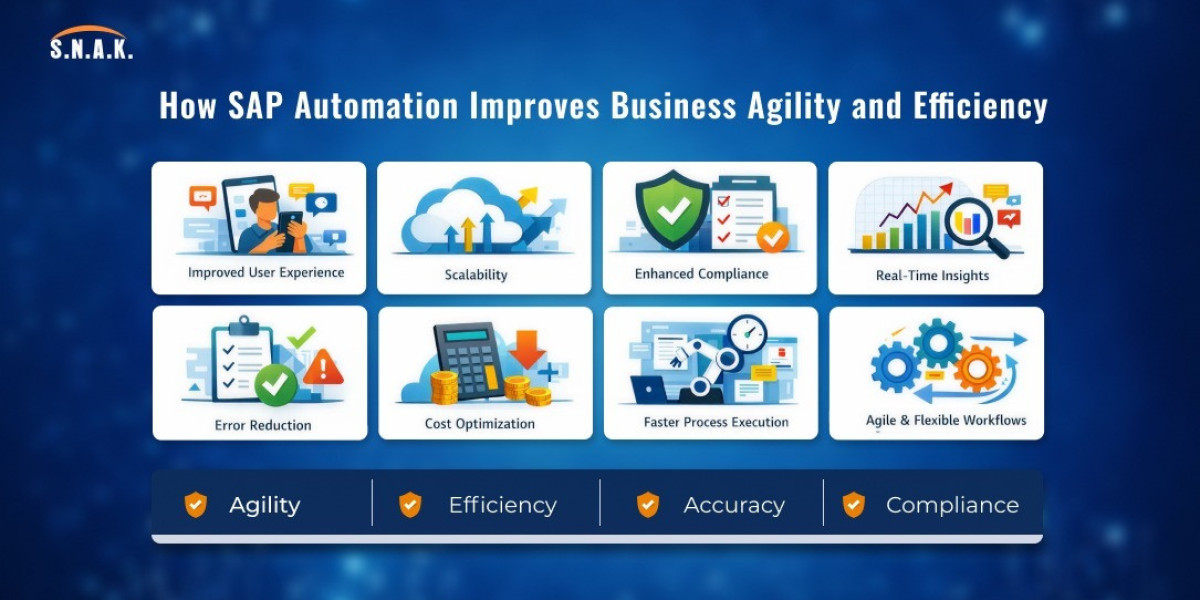
By combining SAP solutions, intelligent automation, and real-time data insights, organizations can significantly improve business agility and operational efficiency. This blog explores how SAP automation works, its key benefits, and why enterprises across industries are adopting it to stay competitive.
What Is SAP Automation?
SAP Automation refers to the use of intelligent technologies such as SAP S/4HANA, SAP Intelligent RPA, SAP BTP, AI, and machine learning to automate repetitive, rule-based, and data-intensive business processes across SAP systems.
SAP automation enables organizations to:
1. Reduce manual effort
2. Eliminate errors
3. Accelerate workflows
4. Improve process visibility
5. Enable faster, data-driven decisions
From finance and supply chain to HR and manufacturing, SAP automation enhances end-to-end business operations.
Why Business Agility and Efficiency Matter Today
Modern enterprises face:
1. Rapid market fluctuations
2. Increasing customer expectations
3. Pressure to reduce operational costs
4. Complex IT landscapes
To survive and grow, businesses need:
1. Agility to adapt quickly
2. Efficiency to do more with fewer resources
SAP automation solutions directly address both.
How SAP Automation Improves Business Agility
1. Faster Decision-Making with Real-Time Data
SAP automation integrates real-time data across systems using SAP S/4HANA and analytics tools. Automated reporting and dashboards provide instant insights, enabling leadership to make quicker and more informed decisions.
2. Rapid Process Adaptation
Automated SAP workflows can be easily modified as business rules change. Whether it’s pricing updates, compliance requirements, or customer processes, automation allows businesses to adapt without major system overhauls.
3. Seamless Integration Across Systems
Using SAP BTP (Business Technology Platform), organizations can integrate SAP with third-party applications like CRM, ERP, Power BI, and cloud platforms. This connectivity enhances agility by eliminating data silos.
4. Scalability for Business Growth
SAP automation supports business scalability by handling increased transaction volumes without additional manpower. As demand grows, automated systems scale effortlessly.
How SAP Automation Boosts Operational Efficiency
1. Reduction in Manual and Repetitive Tasks
SAP Intelligent RPA automates routine tasks such as invoice processing, order entry, payroll, and reconciliations—freeing employees to focus on strategic activities.
2. Improved Accuracy and Compliance
Automation minimizes human errors and ensures compliance with predefined rules and regulations. This is especially critical in finance, procurement, and regulated industries.
3. Lower Operational Costs
By reducing manual labor, rework, and delays, SAP automation significantly lowers operational costs while improving productivity.
4. Enhanced Supply Chain Efficiency
SAP automation enables predictive planning, automated inventory management, demand forecasting, and supplier collaboration—resulting in faster deliveries and reduced stockouts.
9. Better Employee Productivity
Employees spend less time on repetitive tasks and more time on innovation, customer engagement, and problem-solving, leading to higher job satisfaction and productivity.
Key SAP Automation Technologies Powering Efficiency
1. SAP S/4HANA – Real-time digital core
2. SAP Intelligent RPA – Robotic process automation
3. SAP BTP – Integration, analytics, and automation platform
4. AI & Machine Learning – Predictive and intelligent automation
5. SAP Analytics Cloud – Data-driven insights
These technologies together create an intelligent enterprise ecosystem.
Industry Use Cases of SAP Automation
Manufacturing
1. Automated production planning
2. Predictive maintenance
3. Inventory optimization
Retail
1. Automated order processing
2. Demand forecasting
3. Customer analytics
Finance
1. Automated invoicing and reconciliations
2. Faster month-end closing
3. Compliance automation
Healthcare
1. Patient data processing
2. Billing automation
3. Supply chain optimization
Why Choose SAP Automation for Digital Transformation?
SAP automation is not just about efficiency—it is about future-ready digital transformation. Organizations that invest in SAP automation gain:
1. Faster go-to-market
2. Better customer experiences
3. Data-driven operations
4. Long-term competitive advantage