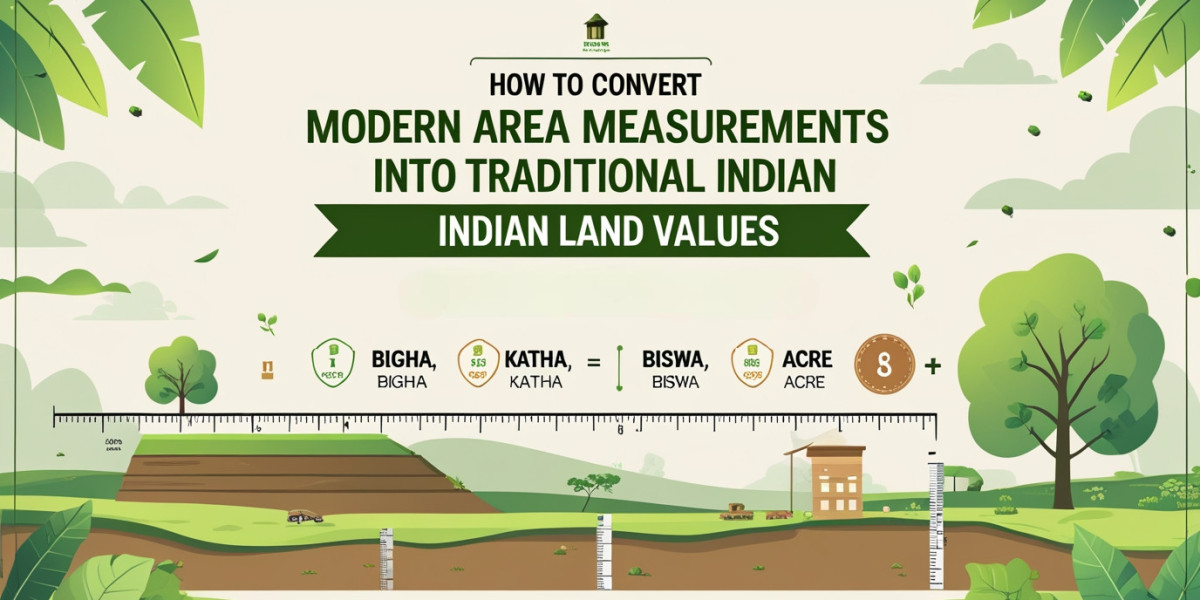

Land measurement in India is a fascinating blend of modern systems and traditional practices. While urban planning, real estate portals, and government records increasingly rely on standardized units like meters and square meters, traditional units such as bigha continue to play a crucial role—especially in rural and semi-urban regions. Understanding how to convert modern area measurements into traditional Indian land values is essential for buyers, sellers, investors, and even legal professionals.
Why Land Measurement Conversion Matters in India
India’s land measurement system is not uniform. Unlike countries that follow a single nationwide standard, India uses a mix of metric units and regional land values. While meters are widely accepted in official documents, bigha remains deeply rooted in local land dealings.
This difference creates challenges such as:
Misinterpretation of land size during purchase or sale
Pricing mismatches due to incorrect area assumptions
Legal disputes caused by conversion errors
Difficulty comparing properties across regions
Learning how to convert between meters and bigha ensures transparency and informed decision-making. Whether you are a buyer, seller, or investor, mastering meter to bigha conversion is a small step that delivers significant long-term value.
Understanding the Meter as a Modern Measurement Unit
The meter is a globally accepted metric unit used for measuring length and area. In real estate, land size is usually expressed in:
Square meters
Square feet
Hectares
Government surveys, municipal records, and digital land databases typically rely on meters because they are standardized, precise, and easy to calculate. Urban developers and planners prefer meters as they align with international measurement practices.
However, when this modern data reaches local markets, it often needs to be translated into traditional units like bigha to make sense to landowners and farmers.
What Is a Bigha and Why Is It Still Used?
Bigha is one of the oldest land measurement units in India, and its value varies significantly by region. Unlike meters, bigha does not have a fixed nationwide size. This variation is why many people struggle with accurate conversions.
For example:
In Uttar Pradesh, one bigha is commonly around 2,500 square meters
In Rajasthan, a bigha can range from 1,600 to 2,700 square meters
In Bihar and West Bengal, the measurement differs again
Despite the lack of standardization, bigha remains popular because:
Local communities understand it intuitively
Agricultural land is traditionally measured this way
Verbal land agreements often reference bigha
The Core Challenge: Converting Meter to Bigha Accurately
The biggest issue in conversion lies in regional variation. A direct formula does not work unless you know the local definition of bigha. This is why relying on assumptions can lead to costly mistakes.
When converting meter to bigha, you must always ask:
Which state or district is the land located in?
What local standard is being followed?
Is the conversion for legal documentation or estimation only?
Ignoring these questions can result in inaccurate land valuation.
Common Conversion Examples Across States
Although exact values differ, here are approximate references to help understand how conversion works conceptually:
In many North Indian states, 1 bigha ≈ 2,500 square meters
In parts of Central India, 1 bigha ≈ 1,600 square meters
In Eastern India, 1 bigha ≈ 1,330 square meters
These numbers should never replace official records, but they help illustrate why location matters so much.
Using Online Tools for Reliable Conversion
With increasing digitization, many people now rely on online calculators to simplify land measurement conversions. A reliable and accurate tool saves time and minimizes human error.
The Best meter to bigha convertor typically offers:
State-wise or region-specific conversion values
Instant and accurate results
Easy-to-use interfaces for non-technical users
Support for multiple land units
Such tools are especially useful for real estate professionals who handle properties across different regions.
Practical Use Cases for Meter to Bigha Conversion
Understanding these conversions is valuable in multiple scenarios:
Real Estate Transactions
Buyers can verify whether the quoted land size matches official records, avoiding overpayment.
Agricultural Planning
Farmers often need to align government subsidy data (in meters) with local land understanding (in bigha).
Legal Documentation
Lawyers and surveyors require precise conversions to ensure consistency across agreements.
Property Valuation
Accurate land size directly impacts pricing, taxation, and resale value.
Tips to Avoid Conversion Mistakes
To ensure accuracy when converting modern measurements into traditional land values, follow these best practices:
Always confirm the local definition of bigha
Cross-check results using more than one conversion method
Refer to government land records when available
Use trusted digital tools instead of manual calculations
Avoid generalizing conversions across states
These steps help eliminate confusion and reduce the risk of disputes.
SEO Perspective: Why People Search for Conversion Information
From a digital standpoint, land measurement conversion is a high-intent search topic. Users looking for precise information are often in the middle of a purchase or sale decision. Long-tail searches like “how to convert square meter land into bigha in India” or “state wise land measurement conversion guide” reflect the growing demand for clarity in this area.
Content that explains both the logic and limitations of conversions builds trust and authority, which is essential for long-term SEO performance.
The Future of Land Measurement in India
As India continues to digitize land records through initiatives like online registries and GIS mapping, metric units will become even more prominent. However, traditional units like bigha are unlikely to disappear anytime soon.
Instead, the future lies in seamless integration—where digital platforms automatically translate meters into locally understood values. Until then, education and accurate tools remain the best solution.
Final Thoughts
Converting modern area measurements into traditional Indian land values is not just a mathematical task—it is a practical necessity shaped by culture, region, and real-world usage. Understanding the relationship between meters and bigha empowers individuals to make informed decisions, avoid misunderstandings, and protect their investments.
By using reliable tools like the Best meter to bigha convertor and staying aware of regional differences, you can confidently handle land transactions without confusion.