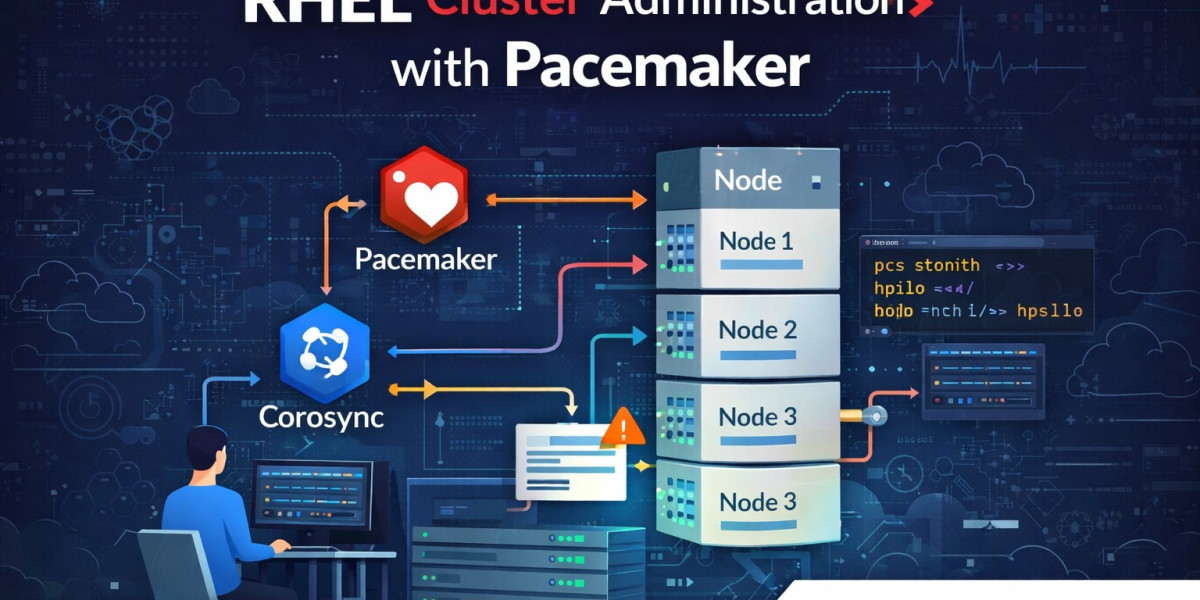

In enterprise IT environments, uptime is not optional—it is a requirement. Critical applications, databases, and services must remain available even during hardware failures, software crashes, or maintenance activities. RHEL Cluster Administration with Pacemaker focuses on building, managing, and maintaining high availability (HA) clusters on Red Hat Enterprise Linux, ensuring business continuity and system reliability.
Introduction to RHEL High Availability Clusters
A RHEL high availability cluster is a group of Linux systems (nodes) that work together to provide continuous service availability. When one node fails, cluster-managed services automatically move to another healthy node, minimizing downtime and preventing service disruption.
Such clusters are commonly used for enterprise workloads like web servers, databases, middleware platforms, and infrastructure services where downtime can result in financial loss or operational impact.
Role of Pacemaker in RHEL Clusters
At the heart of RHEL cluster administration is Pacemaker. Pacemaker is responsible for monitoring cluster nodes and resources, making intelligent decisions about where services should run and when failover should occur.
Pacemaker handles:
- Starting and stopping services
- Monitoring resource health
- Automatic failover and recovery
- Resource placement and constraints
- Triggering fencing actions when required
It works closely with Corosync, which provides reliable communication, cluster membership tracking, and quorum calculation.
Core Components of an RHEL Cluster
A typical RHEL HA cluster consists of several key components:
- Cluster Nodes: Physical or virtual RHEL systems
- Corosync: Handles messaging and quorum
- Pacemaker: Manages resources and failover
- PCS (Pacemaker Configuration System): Administration tool
- Fencing (STONITH): Protects data integrity
- Shared Storage (optional): Used for stateful services
Understanding how these components interact is essential for effective cluster administration.
Installing and Configuring the Cluster
RHEL cluster administration begins with installing the required HA packages and configuring secure communication between nodes. Administrators authenticate cluster nodes, define cluster names, and start cluster services.
Once the cluster is up, administrators verify node status, quorum, and cluster health before adding any application resources. This initial validation is critical for stable cluster behavior.
Resource Management in RHEL Clusters
Managing resources is a central responsibility of cluster administrators. Resources can include:
- Virtual IP addresses
- File systems and storage mounts
- Web servers and application services
- Databases and custom applications
Administrators define ordering and colocation constraints to control how resources start, stop, and move during failover. This ensures services come online in the correct sequence and always run on appropriate nodes.
Failover and Recovery Operations
Failover is the core function of an HA cluster. When a node or service fails, Pacemaker automatically relocates affected resources to a healthy node.
Cluster administrators regularly test failover scenarios to ensure:
- Services move correctly between nodes
- Virtual IPs follow active services
- Applications recover cleanly without data loss
Understanding both automatic and manual recovery procedures is critical for handling real production incidents.
Fencing and Quorum Management
Fencing and quorum are essential safety mechanisms in RHEL clusters. Quorum ensures that the cluster has majority agreement before making decisions, preventing split-brain situations.
Fencing, often implemented using STONITH, ensures that a failed or unresponsive node is completely isolated before resources are restarted elsewhere. Proper fencing configuration is mandatory in production environments to protect shared data and maintain cluster integrity.
Monitoring and Troubleshooting
Effective RHEL cluster administration requires continuous monitoring and proactive troubleshooting. Administrators use cluster status tools and logs to identify issues early and prevent outages.
Common troubleshooting tasks include:
- Investigating failed resources
- Resolving quorum loss
- Diagnosing fencing failures
- Handling maintenance safely
Strong troubleshooting skills significantly reduce downtime and improve cluster reliability.
Best Practices for RHEL Cluster Administration
Experienced administrators follow strict best practices, including:
- Always enabling and testing fencing
- Avoiding manual service starts outside the cluster
- Testing failover after every configuration change
- Keeping node configurations consistent
- Documenting cluster architecture and procedures
These practices ensure predictable and stable cluster behavior in production.
Enterprise Use Cases
RHEL clusters with Pacemaker are widely used across industries such as:
- Banking and financial services
- E-commerce platforms
- Healthcare systems
- Telecom infrastructure
- Enterprise data centers
Organizations rely on these clusters to meet uptime, compliance, and reliability requirements.
Career Value of Pacemaker Skills
Expertise in RHEL Cluster Administration with Pacemaker is highly valued in the job market. Professionals with strong HA skills are trusted to manage mission-critical systems and reduce operational risk.
These skills are especially relevant in environments built on Red Hat, where high availability is a standard requirement.
Conclusion
RHEL Cluster Administration with Pacemaker is a critical skill for managing enterprise Linux environments that demand high availability and reliability. By mastering cluster architecture, resource management, failover handling, fencing, and troubleshooting, administrators can build resilient systems that withstand failures gracefully.
With proper configuration, regular testing, and adherence to best practices, Pacemaker-based RHEL clusters provide a robust foundation for running mission-critical workloads with minimal downtime and maximum stability.