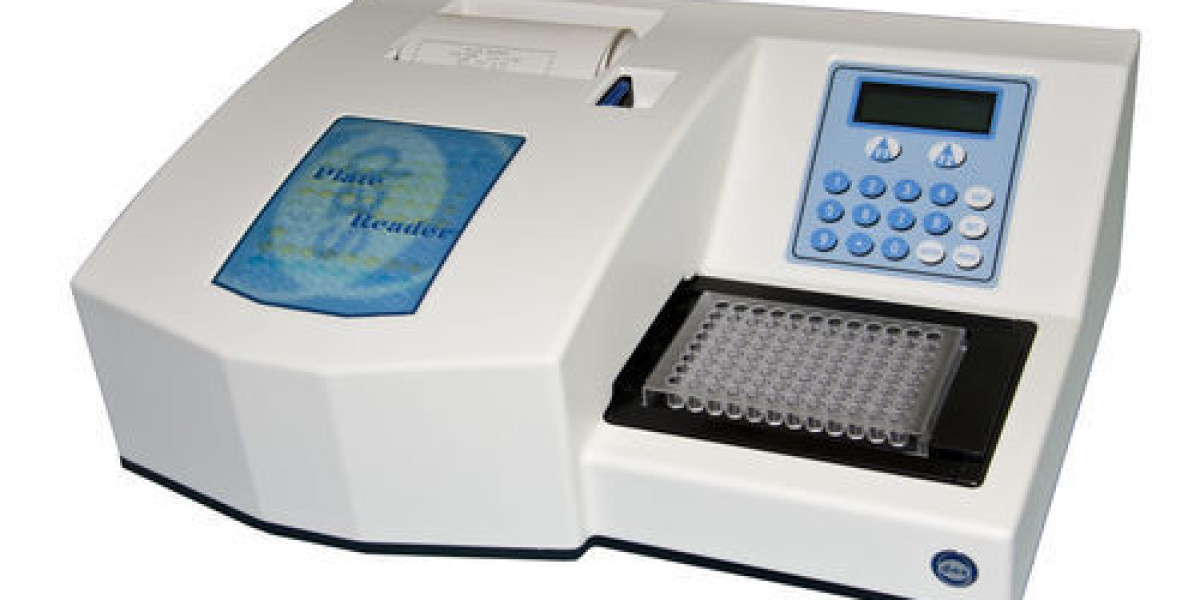

If you have ever run an ELISA test, you know the real magic happens at the reading stage. After all the washing, incubating, pipetting, and timing, it is the ELISA microwell plate reader that turns your hard work into meaningful numbers. Without it, you would be stuck guessing absorbance values or trying to interpret color changes by eye, and that is not something any lab wants to rely on.
The beauty of diagnostics is that clarity matters. You want results that are sharp, accurate, and reliable enough to guide important decisions. That is where the ELISA reader steps in. It takes a simple color change and turns it into quantitative data that you can trust. If you understand how it works, you can also understand how to get the best possible performance out of it.
In this article, we will walk through how an ELISA microwell plate reader works and why it plays such a crucial role in modern diagnostics. Whether you run clinical assays, research-based ELISAs, or routine testing, understanding the science behind the reader helps you choose the right one and use it more effectively.
How the ELISA Microwell Plate Reader Actually Works
The function is simple enough. The reader shines light through each well of a microplate and measures how much of that light gets absorbed. The more color produced in the reaction, the higher the absorbance. This absorbance correlates with the concentration of your target analyte through a standard curve.
A good ELISA microwell plate reader does this with precision. It uses stable light sources, accurate detectors, and controlled wavelength selection. Most diagnostic assays rely on wavelengths around 450 nm, often with a reference wavelength like 630 nm to improve clarity.
When your plate goes into the instrument, the reader captures the absorbance of every well within seconds. You get a full data set that is ready for interpretation, reporting, or export to your LIMS. That level of automation reduces manual error and keeps your workflow consistent.
Why Your Diagnostics Depend on the Reader
An ELISA microwell plate reader affects more than just the final step in your assay. It shapes the accuracy, reliability, and reproducibility of your entire diagnostic process. If the reader drifts, produces uneven illumination, or struggles with wavelength stability, your results can shift without warning.
This matters in real-world diagnostics. A small shift in absorbance can change a borderline negative into a borderline positive. A test that relies on subtle distinctions needs a reader that does not introduce its own variations.
Trusted companies like NE LabSystems carry models designed for clinical reliability, offering clear optics, stable measurement, and intuitive software. Choosing the right reader helps protect the integrity of your outcomes.
What Makes Some Readers Better Than Others
There are several features that separate basic readers from diagnostic-grade ones. Stability is one. The ability to hold consistent readings across time and temperature changes is another. Some readers allow you to program methods, run multi-wavelength measurements, or automate data reporting.
For high workload environments, you want a reader that works as quickly as you do. Fast plate reading, smooth mechanics, and simple calibration routines save you time while reducing stress on the instrument.
If your workflow requires flexibility, look for a model that supports strips as well as full plates. Labs that process partial batches benefit from readers that handle microstrips without forcing you to run a full plate each time. This practical advantage makes your workflow more efficient.
Trusted suppliers like NE LabSystems offer readers that balance speed, accuracy, and ease of use. These systems support both routine diagnostics and demanding research workflows.
Final Thoughts
When you understand how your ELISA microwell plate reader works, you get better results, smoother workflows, and more confidence in your diagnostics. It is one of those tools that does not get much attention until something goes wrong, but when it is functioning well, your entire workflow feels easier.
If you want reliable data and consistent performance, choosing the right reader and using it properly makes all the difference. A well-selected reader supports every ELISA assay you run and helps ensure that the decisions based on your data are the right ones.