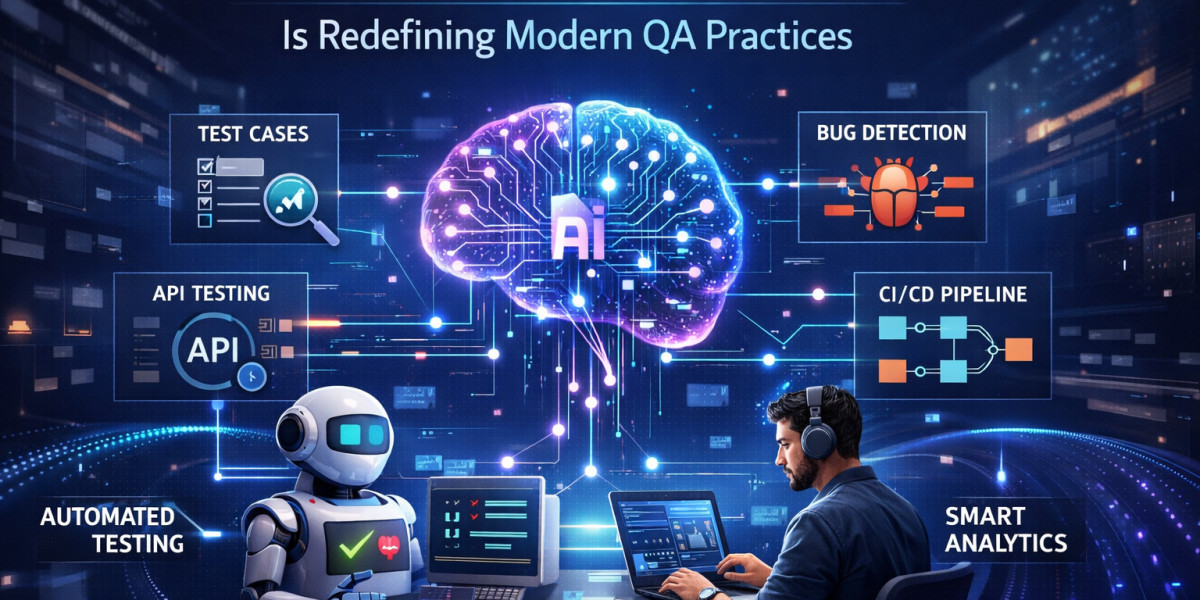

Software quality assurance is no longer limited to finding bugs after development. With increasing release frequency, complex architectures, and higher user expectations, testing must evolve. AI in software testing has emerged as a powerful solution, enabling teams to move from reactive testing to intelligent, proactive quality engineering.
Artificial intelligence introduces learning, reasoning, and adaptability into testing workflows, making QA smarter, faster, and more aligned with real-world usage.
Why Traditional Testing Struggles at Scale
Manual and rule-based automated testing systems rely heavily on predefined logic. As applications grow, maintaining test scripts becomes time-consuming and error-prone. Minor UI or API changes can break entire test suites, slowing down releases and increasing maintenance costs.
This is where AI-driven testing stands apart. Instead of relying solely on static rules, AI systems learn from application behavior, test results, and user interactions to continuously improve testing accuracy and coverage.
AI-Powered Test Intelligence
At the core of AI in software testing is test intelligence. AI models analyze historical test executions, production logs, and defect data to answer critical questions such as:
Which features are most likely to fail?
Which test cases should run first?
Where should testing efforts be focused?
This intelligence allows teams to prioritize high-risk areas, reduce redundant testing, and deliver faster feedback to developers.
The Role of Generative AI Testing Tools
A major breakthrough in intelligent testing is the rise of generative ai testing tools. Unlike traditional automation tools, generative AI can create new test artifacts rather than just execute existing ones.
These tools can automatically:
Generate test cases from API specifications or application flows
Create realistic test data for edge cases
Adapt test logic when application behavior changes
By reducing dependency on manually written scripts, generative AI significantly lowers test maintenance overhead while improving overall test coverage.
Smarter Scenario Testing with AI
Modern applications involve complex user journeys across multiple services and platforms. Scenario testing ensures that these real-world workflows function correctly from end to end.
AI enhances scenario testing by identifying meaningful scenarios based on real usage data rather than assumptions. Instead of testing every possible path, AI highlights the most impactful scenarios—those that users actually follow and those most likely to break.
This approach ensures higher confidence in production readiness without increasing test execution time.
AI Across the Testing Lifecycle
AI is not limited to a single testing phase. Its impact spans the entire software lifecycle:
During development: AI suggests test cases and identifies risky code changes
During integration: Intelligent systems validate service interactions and data flows
Before release: AI prioritizes critical regression tests
After deployment: Production data feeds back into AI models to improve future testing
This continuous learning loop enables true shift-left and shift-right testing strategies.
Business Benefits of AI-Driven Testing
Adopting AI in testing delivers tangible business value:
Faster release cycles with fewer defects
Reduced test maintenance costs
Improved user experience through realistic testing
Better alignment between QA, development, and product teams
Organizations that leverage AI-driven testing gain a competitive edge by delivering stable, high-quality software at speed.
Getting Started with AI in Software Testing
Successful adoption of AI testing requires a strategic approach. Teams should begin by integrating AI into existing automation workflows, focusing on areas like test prioritization or scenario generation. Over time, advanced capabilities such as generative testing and predictive defect analysis can be introduced.
Rather than replacing testers, AI augments their expertise—freeing them to focus on exploratory testing, quality strategy, and innovation.
Conclusion
The future of quality assurance lies in intelligent automation. AI in software testing transforms testing from a bottleneck into a strategic enabler. By combining generative ai testing tools with AI-enhanced scenario testing, teams can achieve faster releases, stronger reliability, and higher customer satisfaction.